NASA’s Psyche Spacecraft Executes Precise Mars Gravity Assist to Unlock Solar System Mysteries

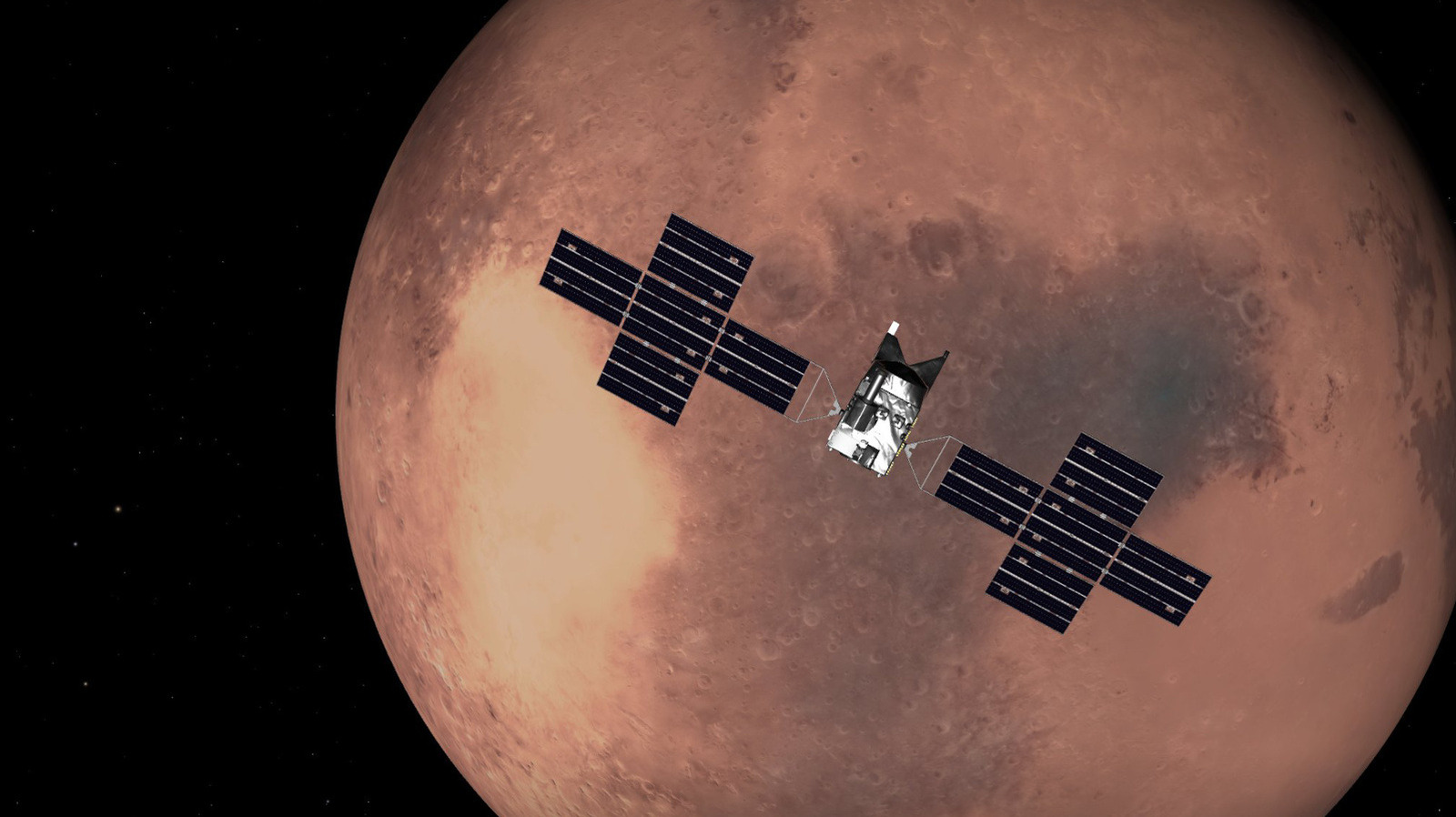
- NASA’s Psyche spacecraft successfully utilized a Mars gravity assist to boost its velocity and conserve critical xenon propellant for its mission.
- The spacecraft passed within 2,800 miles of Mars, capturing unique imagery that will be transmitted via the Deep Space Network.
- The mission aims to reach the metal-rich asteroid 16 Psyche by July 2029 to study the origins of planetary cores and the early history of the solar system.
A Pivotal Maneuver in Deep Space Navigation
NASA’s Psyche spacecraft has successfully completed a critical gravity assist flyby of Mars, a strategic maneuver designed to accelerate the probe toward its ultimate target: the unique metal-rich asteroid 16 Psyche. On May 15, 2026, the spacecraft performed a precise approach, passing within 2,800 miles of the Martian surface—placing it closer to the Red Planet than its own natural moons, Phobos and Deimos.
Strategic Conservation of Ion Propulsion
The primary objective of this flyby was to harness Mars’ gravitational pull to modify the spacecraft’s trajectory and increase its velocity. By utilizing the planet as a cosmic slingshot, NASA engineers are able to conserve precious xenon gas propellant. The Psyche mission relies on a sophisticated solar-electric ion thruster system, and minimizing propellant consumption during this phase is vital to ensuring the spacecraft remains fully operational throughout its long-duration mission.
Traveling at approximately 12,300 mph, the spacecraft utilized its onboard camera systems to capture high-resolution imagery of the planet during the encounter. NASA is currently utilizing the Deep Space Network (DSN) to downlink these images, which will provide fresh visual data regarding the Martian crescent and atmospheric dust profiles. These images are scheduled to be published on the official Psyche mission portal as they are processed.
The Journey to 16 Psyche
Launched in late 2023, the Psyche spacecraft is currently over two years into its ambitious 2.2-billion-mile odyssey. It is projected to rendezvous with the asteroid 16 Psyche in July 2029. Upon arrival, the spacecraft will initiate a two-year observation campaign, which includes mapping the asteroid’s topography, analyzing its composition, and studying its magnetic field.
Scientific interest in 16 Psyche is profound. Researchers hypothesize that the asteroid is the exposed metallic core of an early planetesimal—a building block of a rocky planet that failed to fully form. Because humans cannot drill into the Earth’s own core to study its composition, 16 Psyche serves as a rare, tangible laboratory for understanding the violent, early formation processes of our solar system.
Mission Objectives:
- Composition Analysis: Determine the mineralogy and metallic structure of the asteroid.
- Mapping: Create high-fidelity surface maps to identify geological features.
- Geological History: Gain insights into the collision and accretion history of planetesimals.
As the mission progresses, this successful gravity assist proves that precision engineering, combined with the natural mechanics of our solar system, remains the most efficient way to navigate the immense voids of deep space.