NASA’s Psyche Spacecraft Executes Precise Martian Flyby to Propel Its Deep-Space Mission

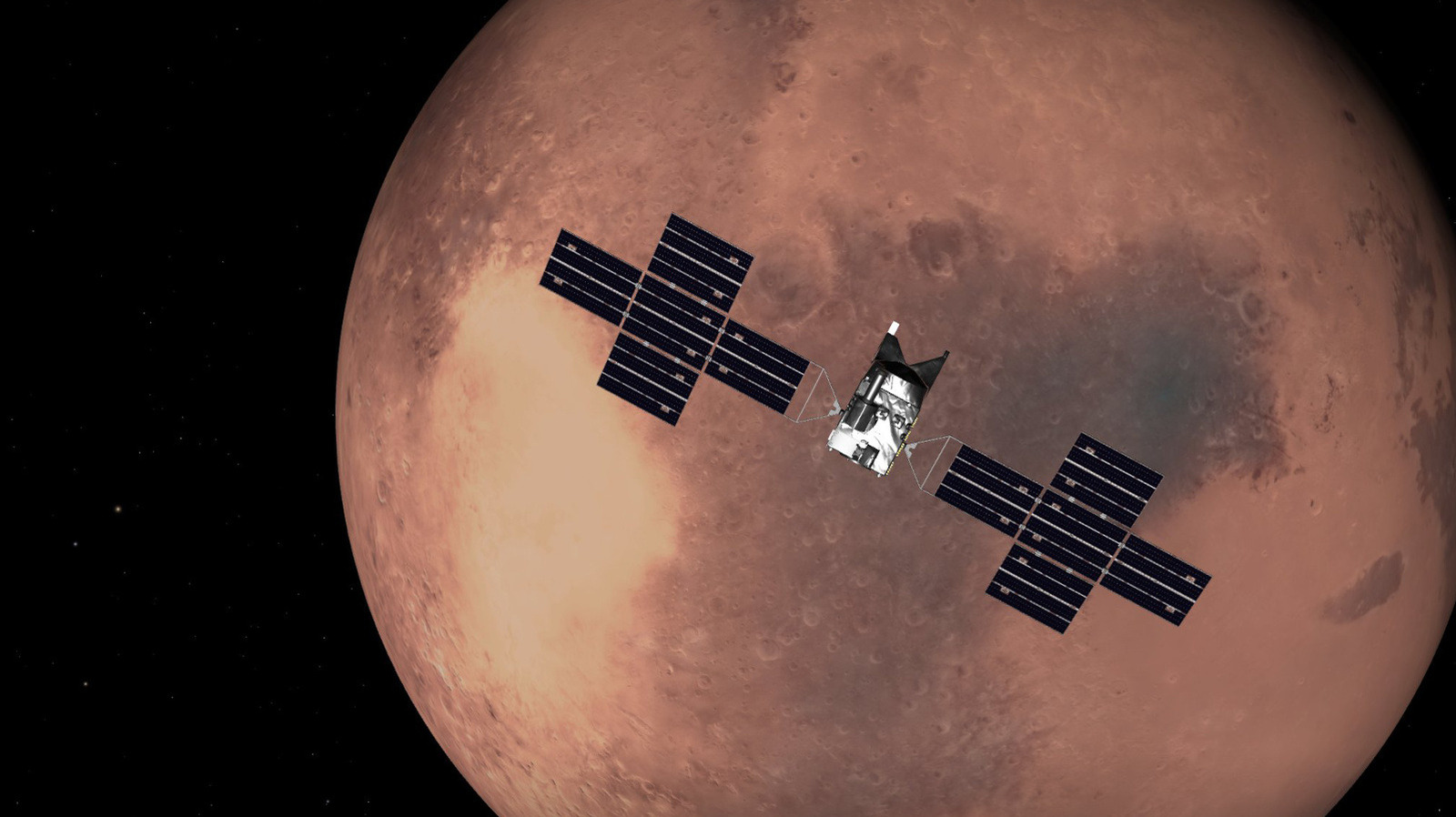
- NASA's Psyche spacecraft performed a critical Mars flyby, utilizing a gravity assist to refine its trajectory and conserve essential xenon ion fuel.
- The probe captured unique imagery of Mars during the maneuver, which is currently being relayed back to Earth via the Deep Space Network.
- The mission aims to reach the metallic asteroid 16 Psyche by July 2029 to investigate the core of an ancient planetesimal, offering insights into the formation of rocky planets like Earth.
The Strategic Mars Gravity Assist
NASA’s Psyche spacecraft has successfully completed a critical milestone in its multi-year journey, performing a gravity-assist flyby of Mars. On May 15, 2026, the probe made its closest approach to the Red Planet, passing at a distance of approximately 2,800 miles—significantly closer than the orbit of Mars’ moon Phobos, which sits at roughly 3,700 miles. This maneuver was not merely a navigational waypoint but a sophisticated fuel-saving strategy designed to optimize the probe’s trajectory toward the metal-rich asteroid 16 Psyche.
Conservation of Propulsion Resources
The core objective of the flyby was to harness Mars’ gravitational pull to accelerate the spacecraft and align it with the asteroid’s solar orbit. By leveraging orbital mechanics, NASA engineers have successfully conserved the spacecraft’s precious xenon gas propellant. The Psyche mission relies on advanced solar-electric ion thrusters, and preserving this onboard fuel is vital for the extensive maneuvering required once the spacecraft reaches its namesake destination in 2029.
Traveling at a velocity of 12,300 mph during the encounter, the probe utilized its onboard cameras to capture unique imagery of Mars. As the spacecraft approached from a specific orbital angle, the Red Planet appeared as a brilliant, thin crescent, backlit by the Sun. These high-resolution images are currently being transmitted back to Earth via the Deep Space Network (DSN), with NASA expected to release the findings on the mission’s official portal in the coming weeks.
Unlocking the Secrets of a Metallic World
The mission’s ultimate target, 16 Psyche, remains one of the most intriguing objects in the solar system. Scientists hypothesize that the asteroid is the exposed iron-nickel core of a shattered planetesimal—a primordial building block from the dawn of our solar system. Studying this massive metallic body offers an unprecedented opportunity to understand the internal composition of rocky planets, including Earth.
Mission Timeline and Scientific Goals:
- 2023: The spacecraft launched on a 2.2-billion-mile trajectory.
- July 2029: Arrival at the 16 Psyche asteroid.
- 2029–2031: A two-year observation window dedicated to surface mapping, composition analysis, and collecting gravity data.
By bypassing the impossibility of drilling into the Earth’s own core, the Psyche mission provides a remote, yet high-fidelity, window into the violent, high-energy collisions that defined the formative years of our planetary neighbors. As the probe continues its deep-space transit, the successful Mars assist stands as a testament to the precision of modern orbital navigation.